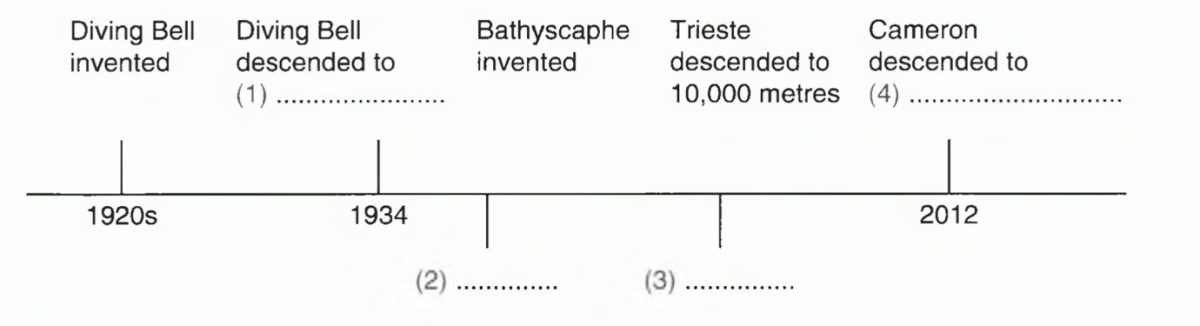
You will hear a recording of a lecture on deep sea exploration. Listen to the first part of the lecture and complete the time line using NO MORE THAN TWO WORDS/ OR NUMBERS from the recording.Bấm vào hình để phóng to
1Câu 1
2Câu 2
3Câu 3
4Câu 4
Transcript
Good evening. My talk this evening will cover three main themes. First, I’ll outline a timeline of how deep-sea exploration vessels developed. Secondly, I’ll describe the most recent of these, the Deep-Sea Challenger, and finally, I’ll look at some of the benefits of this deep-sea research.
OK. To start with, let’s look at how underwater exploration vehicles have developed over the years. The first manned deep sea exploration vessel was invented in the 1920s. It was called a bathysphere, better known as a Diving Bell. It was basically a round metal structure with windows with just enough room for two men to sit in, and it was lowered into the ocean on a cable. The first descent in the Diving Bell took place in 1930, and in 1934 it went down to a depth of nearly a thousand meters, which was impressive for the time. The problem with Diving Bell was that it had no power of its own and there wasn’t much room for the researchers to move around. So, the next development after the Diving Bell was the bathyscaphe, a small manned submarine, invented in the 1940s. The difference between the two was that the bathyscaphe had its own power source which allowed the scientists to investigate in the depths of the ocean more freely. A bathyscaphe called The Trieste reached a record depth of ten thousand meters in 1960. Since then, a new record has been set by James Cameron, who descended to a depth of eleven thousand metres for the first time in 2012.
Bản dịch
Chào buổi tối. Bài nói của tôi tối nay sẽ bao gồm ba chủ đề chính. Đầu tiên, tôi sẽ phác thảo dòng thời gian về cách các tàu thăm dò biển sâu phát triển như thế nào. Thứ hai, tôi sẽ mô tả cuộc thăm dò gần đây nhất trong số này, the Deep-Sea Challenger, và cuối cùng, tôi sẽ xem xét một số lợi ích của nghiên cứu biển sâu.
OK. Để bắt đầu, hãy xem các phương tiện thám hiểm dưới nước đã phát triển như thế nào trong những năm qua. Tàu thăm dò biển sâu có người lái đầu tiên được phát minh vào những năm 1920. Nó được gọi là bathyshpere, hay còn gọi là Diving Bell. Về cơ bản, nó là một khối cấu trúc kim loại hình tròn với cửa sổ chỉ đủ chỗ cho hai người ngồi, và nó được hạ xuống biển bằng một sợi dây cáp. Lần xuống biển đầu tiên của Diving Bell diễn ra vào năm 1930, và vào năm 1934, nó đã xuống độ sâu gần một nghìn mét, một điều rất ấn tượng vào thời điểm đó. Vấn đề với Diving Bell là nó không có năng lượng riêng và không có nhiều chỗ cho các nhà nghiên cứu di chuyển. Vì vậy, sự phát triển tiếp theo sau Diving Bell là bathyscaphe, một loại tàu ngầm nhỏ có người lái, được phát minh vào những năm 1940. Sự khác biệt giữa hai loại tàu là bathyscaphe có nguồn điện riêng cho phép các nhà khoa học tự do nghiên cứu độ sâu hơn dưới đáy đại dương. Tàu bathyscaphe có tên The Trieste đã đạt độ sâu kỷ lục 10.000 mét vào năm 1960. Kể từ đó, kỷ lục mới đã được thiết lập bởi James Cameron, người đã xuống độ sâu 11 nghìn mét lần đầu tiên vào năm 2012.
Từ vựng
Theme (n): chủ đề, đề tài
deep-sea exploration: khám phá biển sâu
deep-sea research: Nghiên cứu biển sâu
underwater exploration vehicle: xe/tàu lặn dưới nước
sea exploration vessel: tàu thăm dò biển
there wasn’t much room for: Không có nhiều chỗ cho